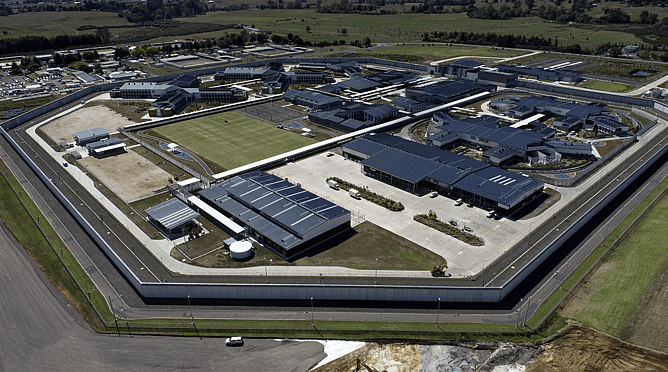
The 596-bed Waikeria prison, 14 kilometres south of Te Awamutu in Waikato. Expansion plans for a further 800-plus beds are underway as the prison population hits an all-time high.
Article Reproduced 15.02.26
I have reproduced this article because of the evidence that we must look after our children's health, mental, emotional, physical, spiritual...humans have the ability to overcome trauma, manage stress, make choices. Children need the space both communally and personally to experience and discover their resilience, empathy and strength to manage to live in an unbalanced world. And systems must change. Our powerful young people
Our prison population has hit an all-time high and is projected to keep growing faster than expected as a result of coalition government policies on law and order.
Here’s Dr Paula Toko King, a kaupapa Māori health researcher, talking to Connie Buchanan about why that’s a problem, both for community safety and the health of whānau who’ve been in prison.
I started off in paediatrics because I really liked working with tamariki and whānau. But I started to see the same things, day in and day out. Things like the lack of good quality housing for whānau, and subsequent preventable childhood illnesses. And I thought: “There must be a better way than just trying to pick up the pieces.”
So I moved into public health medicine and began to focus on tāngata whenua rights to health. I took the perspective that Māori are born with inherent rights to health and wellbeing — and those rights start with our whakapapa from the universe.
Our Indigenous rights today are articulated in documents like He Whakaputanga and Te Tiriti, and are supported by international conventions like the United Nations Declaration on the Rights of Indigenous Peoples. But I felt very strongly that tāngata whenua rights existed already, and those later expressions of rights simply support that.
I ended up working in areas of severe inequity for our people — our tamariki, rangatahi, pākeke, and kaumātua — in state prisons, youth justice, state care, and disability. I use the word tamariki very purposefully in that list too, because the age of criminal responsibility in Aotearoa is 10 years old, so we have children going through the prison system too.
The research I’ve been involved with for the last few years is a kaupapa Māori project called Tiaki. It looks at the impacts of imprisonment on Māori and their whānau. And it considers how to improve wellbeing once those who’ve been in prison are back in the community. What are some of the things that can make life better for them? How can we disrupt the cycles of harm that imprisonment causes?
The reason there’s a need for this work is because the evidence shows over and over again that prisons don’t work. Not in terms of community safety, nor in terms of rehabilitating those who are imprisoned.
Decades of government-commissioned reports and academic research say the same thing. They show that prisons are harmful environments in themselves. They cause more harm and poorer health.
That’s partly because whānau who end up in prison are often already unwell. They have higher rates of mental health issues, addictions, head injuries, and fetal alcohol spectrum disorder. They’re also overrepresented in things like vision loss, hearing loss, and mobility issues. And they have a higher rate of chronic conditions like cancer and cardiovascular stroke.
So they’re a group of people who aren’t well and have higher health needs than the general population. And when we looked at the data on people being released, we found that they had three times the death rate of the general population. The incidence of death was highest in the first month after release. There also had high rates of emergency department presentations, and longer stays in hospital, usually in the first week after release.
So the prison environment exacerbates a whole range of existing conditions.
Just one example of why this might be the case is that around a quarter of released prisoners don’t have access to subsidised primary health care. They’re not enrolled with a Primary Health Organisation (PHO). And why are they not enrolled? Because the Ministry of Health and Health New Zealand rules say that people in prison, or on remand, aren’t allowed to be enrolled with a PHO.
There are so many basic problems, but that’s one of them. In general, the attitude from the Ministry of Health and Health New Zealand to people in prison is: “It’s not our problem.” There’s no integration between the prison and health systems. It’s excessively siloed. But health services should be accessible across the system, no matter where you are.
We hear of this same problem with kids in youth justice residences and other state care. It’s a very similar issue.
Why are kids and adults in prison not receiving health and disability services the same as everyone else? It’s really important that their health needs are addressed, especially if we want people to rejoin society and be contributing community members.
As for the idea that prison promotes community safety — they don’t. Because people aren’t actually in prison for that long, as a rule. What happens most often is that people cycle in and out of prison, up to 100 times, in some cases. They get out. But they’ve been harmed in prison and are largely unsupported to become part of the community again, and then they end up back in prison.
That cycle doesn’t make our communities safer. There’s no evidence to say that prisons give us safe communities. But there is plenty of global and national evidence to show that they cause intergenerational harm.
So for the prime minister to say that it’s a “good thing” that our prison population is now headed toward 11,000 is, to me, an extremely uninformed view. If he reads the government reports — and there have been multiple government reports on this over the last four decades — they show quite clearly that prisons cause harm and don’t make communities safer.
I also think he’s forgetting how much money it costs to keep someone in prison. The cost is phenomenal. It’s almost $200,000 per person, per year.
Meanwhile, the government is doing work through its Social Investment Agency to support tamariki of whānau who are in prison, and tamariki of whānau who’ve been in state care, and tamariki who are excluded from schools. And yes, there should absolutely be investment there. But then, why are they piling people in through the prison doors at the same time, at massive expense, and creating more of those harms that they’re trying to fix at the other end?
Why not equitably invest in kaupapa Māori organisations in the communities, which everyone knows have been underfunded for decades, to support people’s health and wellbeing when they come out? The evidence shows that’s an effective way to help prevent them going into prison in the first place.
Yet lots of people in our society are happy to have vast amounts spent on the mass imprisonment of our Indigenous population. It’s an industry. And the industry relies on society thinking that this is the only way.
But it’s just not a fiscally responsible thing to do.
There’s a reason why the prison population is almost 11,000 now. Legislative changes by this government — including bringing back the “three strikes” law and introducing the Gangs Act — have extended criminalisation by creating new categories of crime. And of course, there are the well-documented racialised inequities across our criminal legal system, which have led to our prison population being over 50 percent Māori in men’s prisons, and over 60 percent Māori in women’s prisons.
The Māori figures are likely higher than that because Corrections has been incorrectly recording ethnicity data. They’ve admitted it. The government has protocols that have been around for 20 years on how to record ethnicity data, but the Department of Corrections didn’t use those. They just did their own thing. They used a made-up system where people in prisons self-identify some sort of “preferred ethnicity” which is totally unrelated to what Statistics New Zealand requires. So there are longstanding inaccuracies in the public reporting of Māori numbers in prisons.
During the research we did as part of the Tiaki project, we realised that there would probably be an undercount of Māori as a result, and of other groups too.
And just as we suspected, there was an undercount of Māori by about 6 percent. That equated to about 405 more Māori in prison than the government statistics say. And that has huge implications when you think about all those people and their tamariki and communities. It’s not just individuals.
The prime minister’s view is the privileged bubble view, where it suits one group to make whole populations invisible. And that makes sense when we think about where prisons came from. They were set up by the colonial state to scoop up anyone who they didn’t want to deal with, or needed out of the way, in much the same way as asylums kept mentally unwell people from society’s view.
I don’t think it’s rocket science. We’ve set prisons up from a system that is rotten and racist to the core, and so the proportion of Māori in prison has kept growing over the years. In the 1900s, we were 2 percent of the overall prison population. Then around 21 percent by about 1945, and more than 50 percent by the 1980s.
But if you want a society that prevents harm and promotes wellbeing, and if you’re thinking critically about the evidence, then you start to think that surely there must be an alternative. I would say: Don’t put people in prison in the first place. We can find other ways of dealing with harm.
I think we should really be critiquing the idea that prisons are inevitable. And listening very closely to our whānau who’ve been in prison. They are the experts on their own lives. In our research, we supported those who had experience of prison to be qualitative researchers or kairangahau. They spoke to dozens of whānau who’d been in prison. Those whānau desperately want things to be different for their tamariki, and they shared their stories for that reason. They have the solutions for those who choose to listen.
In the meantime, there are some pretty basic things that should be done to help whānau who are coming in and out of prisons. The state could clean up its act in terms of its own processes and practices, which are excessively slack.
For starters, Corrections could follow government rules and record ethnicity correctly, so we have an accurate picture of who we’re dealing with and what services in the communities might best help them when they’re out. That’s a no-brainer.
Secondly, Health New Zealand could change the PHO rules so that people who’ve been in prison can access subsidised healthcare when they come out.
It could fund kaupapa Māori health organisations equitably — they’ve been underfunded for years and years — so they can better support those who’ve been imprisoned and harmed by the carceral system.
The state should be accountable for what’s happening now. It should acknowledge that as soon as you create more conditions of harm, you’re going to have a lot of people who’ve been harmed coming out the other end.
But we also know the state is not going to provide long-term solutions because that’s like asking a problem to solve itself.
What I and my research colleagues think is worth doing is valuing the perspectives of those who’ve been in prison. They understand their own challenges better than anyone else. Our whānau have such insight into the solutions that would help their own wellbeing. If there’s something this research has given me, it’s faith that we can rebuild our own world. Trauma isn’t the only thing that can be carried down generations — we can create intergenerational wellbeing and vitality, too.
I’m reminded of something Matua Moana Jackson would say, though I’m paraphrasing. He’d say: Colonisation is a blip. We’ve been around for thousands of years. We have our own tikanga, our own ways of being Māori. And yes, that’s been disrupted, but it isn’t forever.
So I’ll carry on doing this work in the belief that we can collectively rebuild the world that our mokopuna deserve to inherit.
As told to Connie Buchanan
Dr Paula Toko King (Te Aupōuri, Te Rarawa, Ngāpuhi, Ngāti Whātua, Waikato Tainui, Ngāti Maniapoto) is a Public Health Medicine Specialist and Research Associate Professor at Te Rōpū Rangahau Hauora a Eru Pōmare (University of Otago, Wellington) and the Batchelor Institute of Indigenous Tertiary Education, Australia. Her research focuses on upholding tāngata whenua rights to health and wellbeing and the impact of racism, ableism and disablism, state care, youth justice residences and prisons on Māori health and health equity.
E-Tangata, 2026